










Gap Revenue Performance: Why This Book, Why Now
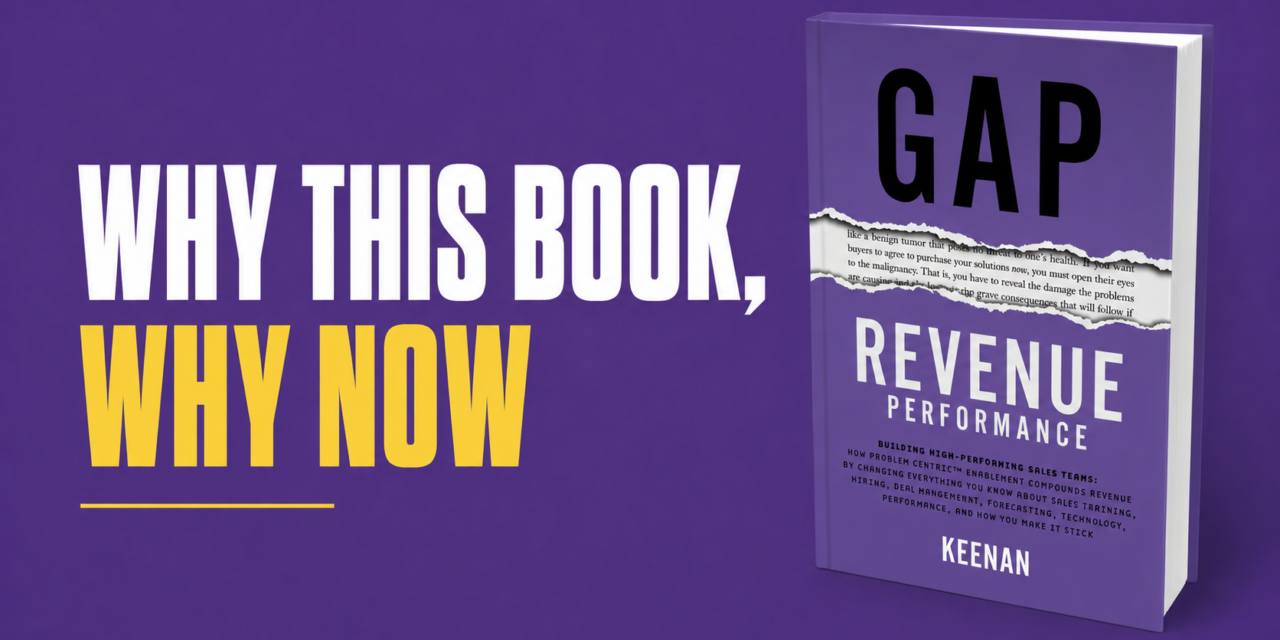
Quick answer: Gap Revenue Performance is Keenan’s book on why companies miss revenue, and it makes the case that the miss is an operating problem rather than a people problem. Most companies have no defined system for how revenue gets produced, so executives are accountable for an outcome they cannot trace: a forecast that moves for reasons no one can locate, a win rate that stays flat through three tool purchases, and growth that depends on a handful of reps who could leave. The book takes the gap thinking behind Gap Selling (2018) and applies it above the deal, to the revenue organization itself: what the current state actually is, what the required future state looks like, and what the distance between them costs. It is written for CROs, CEOs, boards, and private equity operating partners who have to make revenue predictable instead of hoping for it.
Key takeaways
- The book’s core claim: revenue performance is produced by a system, and most companies do not have one.
- It moves gap analysis from the deal to the revenue organization, which is the part of the business still run on judgment alone.
- It is written for the people who own the number at the top, not for reps looking for tactics.
- The argument is diagnostic, not motivational. It asks what your current state is and what it costs, before it asks what to install.
- It explains why sales spend keeps rising while win rates stay flat, and why buying more of the same has not changed the outcome.
- It is relevant now because efficient growth is the standard companies are measured against, and effort is not an efficiency strategy.
- Read it if you cannot answer, in specifics, why your number came in where it did last quarter.
What are revenue leaders actually up against right now?
Revenue leaders are being asked for predictable, efficient growth from an organization nobody ever built to produce it. The board wants a forecast that holds. The CEO wants growth that does not require a proportional increase in headcount. The PE operating partner wants a repeatable motion that survives a leadership change and shows up in the valuation. And underneath all of that sits a sales organization running on individual talent, tribal knowledge, and quarter-end pressure.
We make the number more often than not. What we are not doing is asking at what cost, and whether we could do it again on purpose.
Look at what that costs in a large organization:
- Ask ten reps how they qualify a deal and you get ten answers. – The cost is a forecast assembled from ten different definitions of the same word.
- Managers inspect pipeline and call it coaching. – The cost is a bench that does not get better, quarter after quarter.
- Enablement ships programs with no line connecting them to a business metric. – The cost is real money spent against a result nobody can attribute.
- New reps ramp by sitting next to whoever is good. – The cost is attrition and quota attainment.
- The forecast is built on rep belief rather than buyer evidence. – The cost is your credibility with the board, which you only get to spend once.
None of that is a talent problem. Every one of it is an operating problem, and that is the ground Gap Revenue Performance is standing on.
What is Gap Revenue Performance?
Gap Revenue Performance is a book about how revenue is actually produced inside a company, and what to do when the answer is “we’re not sure.” It applies gap analysis, the same discipline Gap Selling (2018) asked reps to apply to a buyer, to the revenue organization itself.
The structure of the argument is the same at both levels. You cannot improve anything until you know the current state in specific, evidenced terms. You cannot set direction until you define the future state you actually need. And the distance between those two things is not a vague ambition, it is a measurable gap with a price attached to it.
Applied to a company, that means answering questions most leadership teams have never answered on paper:
- How does a deal get qualified here, and does everyone apply that the same way?
- What must a manager see before a deal advances?
- What does the forecast count as evidence?
- What is a rep expected to be able to do at 30, 60, and 90 days, and who verifies it?
- When win rate moves, where do you look first?
The book treats those as operating decisions that belong to the company, not as best practices to be bought.
How is this different from Gap Selling?
Gap Selling is a book for the person in the deal. Gap Revenue Performance is a book for the person who owns the whole number.
Gap Selling changed how a rep runs discovery: stop selling the product, diagnose the buyer’s current state, quantify the impact, and let the gap do the work. It has been used by tens of thousands of sellers since it came out in 2018, and the method holds up at the deal level.
The problem it did not solve is the one leaders keep running into. A method that lives in individual reps is still heroics. It leaves with the person who learned it. It does not survive a reorg, a new manager, or a hiring class. What Gap Revenue Performance takes on is the layer above: how a company defines, connects, and measures the work so that performance belongs to the organization rather than to a few good people.
That is a harder book to write and a harder book to read, because the reader cannot delegate the fix.
Why does the industry need this book now?
Because the market stopped paying for growth at any cost, and the sales profession has not adjusted its operating model to match. Efficient growth is the standard now. Boards, buyers, and investors are all asking the same thing in different language: is this repeatable, and does it survive the people who built it?
Meanwhile the response from most of the market has been to sell more into the same broken structure. More tools, more content, more dashboards, more AI layered on top of a process nobody defined in the first place. If the underlying work is undefined, automating it faster produces undefined work at scale.
Sales is the last major function in most companies still running on judgment alone. Finance has a defined close. Manufacturing has a defined process and feedback loops. Engineering has a defined system of record and a review standard. Sales, the function with the largest budget and the most direct line to the P&L, is frequently the one nobody can diagram.
This book names that, and it does it without the motivational packaging the category usually comes wrapped in.
Who should read Gap Revenue Performance?
Anyone accountable for a revenue number they cannot fully explain. That is a narrower group than “everyone in sales” and a wider one than “sales leaders.”
- CROs and VPs of Sales who are being asked for predictability and are currently producing outcomes rather than repeatability.
- CEOs who have concluded the sales problem is a hiring problem, and have hired three times against it.
- PE operating partners and boards evaluating whether a portfolio company’s growth is a system or a run of good quarters with names attached to it, which is a valuation question before it is an operating one.
- RevOps and enablement leaders who are asked to fix the number with programs and have no authority over how deals get qualified.
If you are looking for prospecting tactics or a better email sequence, this is not that book. It does not pretend to be.
What does the book get right that the market keeps getting wrong?
It refuses to treat performance as a motivation problem. That single move separates it from most of what gets published in this category.
The standard sales book argues that reps need to want it more, work harder, or master one more technique. That framing is comfortable because it puts the burden on individuals and asks nothing of the operating model. It also explains why so many organizations have spent a decade buying training, tooling, and content while their win rates sit where they were.
The second thing it gets right is the insistence on evidence. Current state means what is verifiably true, not what the leadership team believes is true. Most executive teams have a narrative about their sales organization, and the narrative is usually more flattering than the data. The book makes you check.
The third is the cost. An abstract gap does not get fixed. A gap with a number next to it does, because it stops being a philosophy discussion and becomes a business case.
What will make executives uncomfortable in this book?
The part where the diagnosis points at leadership. The book does not let you conclude that the reps are the problem, and for a lot of readers that is the whole reason the book is worth the time.
How reps qualify deals is a decision leadership made or failed to make. What managers coach to is a standard leadership set or left blank. What the forecast counts is a rule leadership wrote or allowed to drift. When those are undefined, the organization runs on whatever each individual decides, and then we call the resulting variance a talent issue.
It works, until it doesn’t. And when it stops working, the reflex is pressure, because pressure is the only lever available when nothing underneath is defined.
Reading this book honestly means accepting that the fix is construction work, it takes longer than a quarter, and it does not get to be delegated to enablement.
Is Gap Revenue Performance worth reading?
Yes, if you own a revenue number and you cannot currently explain in specific terms why it landed where it did. That is the test. If you can trace last quarter’s result to a stage, then to a behavior, then to a decision somebody made, you may already be running the kind of organization this book is describing. Most companies cannot do that.
What you get is a diagnostic frame and a vocabulary for a problem executives have been describing in symptoms for years: the flat win rate, the forecast that will not hold, the top performers whose departure moves the whole number, the enablement spend that never shows up in a business metric. The book connects those into one cause instead of four separate fires.
What you should not expect is a shortcut. There is no play to steal here, because a system is not a play. It is a set of decisions about how your company sells, and this book is about making them deliberately rather than by default.
How do you find out where your org actually stands?
Get an evidenced read on your current state before you decide what to build. The PCOS Capability Assessment and the Four Orgs Assessment at salesgrowth.com take about twenty minutes and give you the same starting point the book asks for: what is true right now, not what the leadership narrative says is true.
Frequently asked questions
Do you need to read Gap Selling first?
No. Gap Selling helps, because the underlying logic of current state, future state, and the gap between them carries over, but Gap Revenue Performance is written for a different reader and stands on its own. Reps read Gap Selling. The people who own the number read this one.
Is this a sales methodology book?
Not in the usual sense. A methodology tells a rep how to run a deal. This is about how a company defines, connects, and measures the work that produces revenue, which includes methodology but does not stop there.
What is PCOS?
PCOS is the Problem-Centric Operating System, A Sales Growth Company’s operating system for connecting the skills reps develop, the deals they work, the forecast leaders commit to, the coaching that sustains it, and how performance gets measured. Gap Revenue Performance is the argument for why an operating system is required. PCOS is one.
Does this apply to companies that are not sales-led?
Yes. The questions do not change with the motion. Product-led and partner-led companies still have a definition of a qualified opportunity, a standard for advancing it, and a forecast built on some kind of evidence. If those are undefined, the same variance shows up, just in a different place.
Is it relevant for a small company, or only for enterprise?
It is relevant earlier than most founders think. A twelve-person sales team with no defined qualification standard becomes a sixty-person sales team with no defined qualification standard, and the cost of fixing it goes up with every hire.
Where can you get it?
Through salesgrowth.com, along with the assessments and the rest of the Gap Selling library.
About the source
Keenan is the CEO of A Sales Growth Company (ASG), the author of Gap Selling (2018) and Not Taught (2015), and the creator of Problem Centric® Selling and the Problem-Centric Operating System (PCOS™). This article introduces Gap Revenue Performance and sits alongside ASG’s Four Orgs series and The Modern Sales Org. To see where your organization stands, visit salesgrowth.com.
Sources
- Gap Selling was published in 2018 by A Sales Guy Publishing.
- Not Taught was published in 2015.
- Problem Centric® Selling, PCOS™, and the Four Orgs model (Heroic, Random, Peacock, Compounding) are frameworks from A Sales Growth Company.
- The comparison to defined operating systems in finance, manufacturing, and engineering is offered as an argument about operating discipline, not as a citation of specific research.