














We Don’t Need Sales Stages Anymore
Quick answer: Sales stages measure what the seller has done, not what the buyer knows, which is why a deal can sit in “Proposal” and still be worth nothing. A better picture is a pie instead of a pipeline. The pie fills with Buyer Input Data (BID), A Sales Growth Company’s structured set of problem-centric evidence a seller collects to prove a deal is real, winnable and forecastable: the problem, its root cause, its impact, the gap, the decision criteria, the buying process. Get some of it and the pie is a quarter full, call it red. Get more, including the quantified definitions behind it, and it is half full, call it yellow. Fill nearly all of it, ASG’s threshold, and it is green. No left to right, no top to bottom. The only question is how much of the buyer’s situation you can actually prove.
Key takeaways
- Stages describe seller activity. Demo scheduled, proposal sent, verbal received. None of that is buyer evidence.
- A funnel, a pipeline and a sales process are all linear pictures. Buying is not linear, so the picture lies.
- The replacement is a pie that fills with BID, and a color that reflects how full it is: red, yellow, green.
- Knowing a problem exists and having defined it are two different things. Only the defined version fills the pie.
- A green deal is not green because it reached a stage. It is green because the buyer gave you enough to prove it.
- This kills the oldest lie in pipeline reviews, which is that a deal deep in the process must be close.
- If you cannot fill the pie, you do not have a deal. You have a conversation with a close date on it.
Why don’t sales stages work anymore?
Because stages track the seller and the buyer is the one making the decision. Look at what a stage actually records: a meeting happened, a demo went out, a proposal got sent, a contract went to legal. Every one of those is something we did. Not one of them is something the buyer confirmed.
So we end up managing a picture of our own activity and calling it deal health. Here’s what that costs, line by line.
- Stage 4 tells you a proposal is out. – It does not tell you the buyer can fund it.
- Stage 5 tells you the deal is in negotiation. – It does not tell you anyone has agreed on what problem is being solved.
- A deal that has been in Stage 3 for ninety days looks like progress that stalled. – Usually it was never a deal at the start.
- Two reps in the same stage can have wildly different deals. – Which makes the stage useless as a comparison.
Then there’s the shape of the thing. A funnel goes top to bottom, a pipeline goes left to right, and a sales process goes step one to step seven. All three say the same thing: progress is movement forward. Gartner’s work on the B2B buying journey (2025) describes buying as anything but that, with buyers looping back through the same jobs repeatedly rather than walking a line, and Fast Company made the same point in 2023 about how nonlinear the journey has become. We’re drawing a straight line on top of something that isn’t straight and then wondering why our forecast is a guess. Fewer than half of sales leaders and sellers report high confidence in their own forecast accuracy (Gartner, 2020).
Challenger’s research on customer indecision (2023) puts a finer point on it: plenty of deals do not die to a competitor, they die because the buyer never got to a decision. A stage cannot see that coming. Stages only see us.
What replaces sales stages?
A pie, and how full it is. Instead of asking where a deal sits in a line, ask how much of the buyer’s situation you can prove, and fill the pie with Buyer Input Data, A Sales Growth Company’s structured set of problem-centric evidence that proves a deal is real, winnable and forecastable.
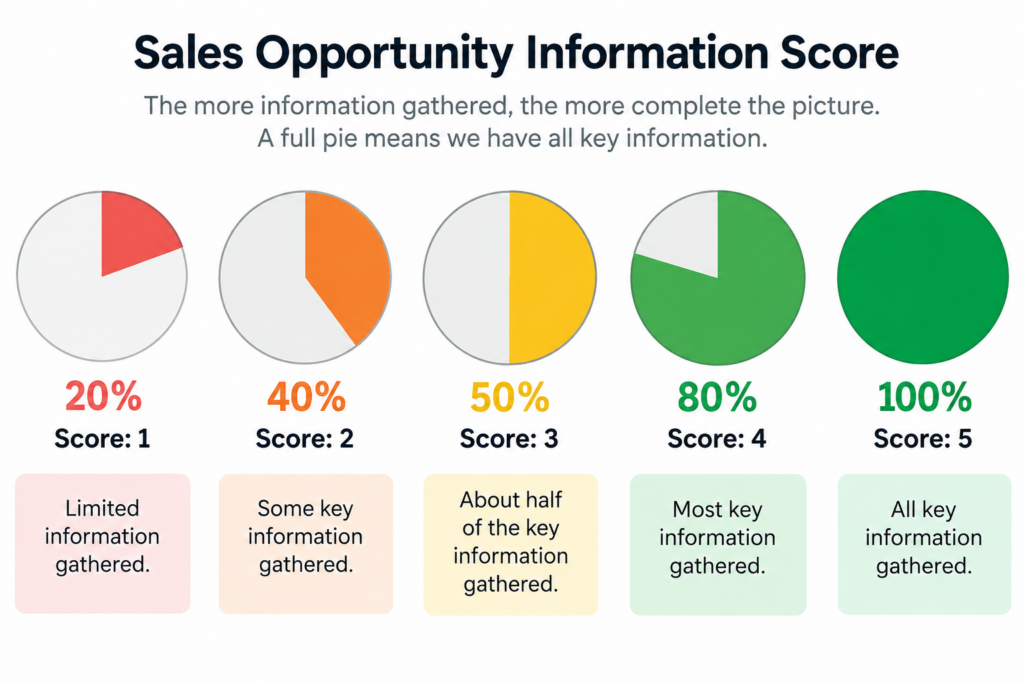
The pie has no direction. There is no “further along.” There is only more filled or less filled, and the color follows the fill.
- Red. You have some of the BID, maybe a quarter of the pie. The buyer admitted a problem. That’s it. Everything else in this deal is your opinion wearing a buyer’s name tag.
- Yellow. About half the pie. You have the problem, and you have some definitions behind it: the size of it, the root cause, a number on the impact. You are out of vibes and into evidence, but there are holes.
- Green. Nearly the whole pie, ASG’s threshold. Problem, root cause, quantified impact, the gap, the cost of doing nothing, the buying process, where they are in it, the decision criteria and whether you actually meet it.
The goal of every call, every email, every conversation, is to fill more of the pie. That’s the job. Not to advance a stage, to fill the pie.
And the beautiful part is a seller cannot fake it. You can move a deal to Stage 4 by sending a proposal nobody asked for. You cannot fill the pie without the buyer handing you something.
What goes in the pie?
The three core components of BID: the problem, the impact, and the gap or desired outcome. That’s the spine. According to ASG, the problem covers what the buyer admits to, the symptoms they feel and whether the root cause is identified and agreed on. The impact covers what the problem is costing today, the risks and inefficiencies tied to it, how often it happens and what fixing it on the fly has cost. The gap covers what they want that they cannot do now, how big the distance is and how urgent closing it feels.
Around that spine sits the rest of what a real deal requires: the decision criteria, whether you meet it, whether it’s even valid criteria, and the buying process, including what it actually is and where in it you currently stand. ASG’s own BID example shows exactly this shape, right down to the CFO requiring a validated cost model before approval.
Here is the distinction that separates a yellow pie from a green one. Knowing and defining are not the same thing.
“They have a rework problem” is knowing. “Here is the share of orders that get manually reworked, here are the hours it burns a quarter and here is what it costs a year” is defining. One is a slice of the pie. The other is a slice you can forecast on.
Most pipelines are full of knowing. Almost none of them are full of defining, and that gap is why deals that looked great in the CRM disappear.
Why does the buyer evidence matter more than the stage?
Because the buyer is the one who has to change, and the evidence is the only proof they can. ASG’s How Buyers Want to Be Sold report, a survey of more than 1,200 B2B buyers, found that 54% had to rescope or re-evaluate after starting their purchase, 41% admitted they bought the wrong solution the first time, 63% wished salespeople had pushed them harder to think through their situation, and 72% said the process focused more on the solution than on their actual problem.
Read that against a stage model. Every one of those buyers moved through our stages. Demo, proposal, negotiation, all of it. The stages advanced perfectly while the buyer was quietly rescoping, re-evaluating or heading for the wrong thing.
Stages measured us doing our process. Nobody measured whether the buyer had what they needed to make a good decision. Fill the pie and you’re measuring exactly that.
Don’t we still need stages for forecasting and consistency?
You need a shared standard, and stages are just a bad one. Clari makes the case that well-defined sales cycle stages give teams consistency and forecast discipline (Clari, 2021), and the want underneath that argument is completely right. Leaders do need one language for deal health that every rep and every manager applies the same way.
The disagreement is about what that language should be made of. A stage name is a label we assign ourselves. A filled pie is evidence the buyer gave us. Both are consistent. Only one of them is true.
Keep whatever stages your CRM needs for plumbing, reporting and revenue recognition. Just stop managing with them. Your deal reviews, your coaching and your forecast should run on how full the pie is, because that’s where BID becomes the raw evidence a forecast can be tested against instead of rep optimism.
A green deal in month two of a nine-month cycle is more forecastable than a red deal sitting in your final stage. Stages cannot tell you that. The pie tells you instantly.
How do you start filling the pie instead of advancing a stage?
Start by scoring your current pipeline on BID and watching the color change. Take your top twenty open deals, and for each one mark what you actually have from the buyer: problem, root cause, quantified impact, gap, cost of inaction, buying process, position in that process, decision criteria and whether you meet it.
Not what the rep believes. What the buyer said, with numbers attached where numbers belong.
Then color them. Most leaders find a pipeline that looked mostly yellow-to-green in the CRM comes back mostly red, and the deals furthest along in the stage model are often the emptiest pies. That’s the moment the whole argument stops being theoretical.
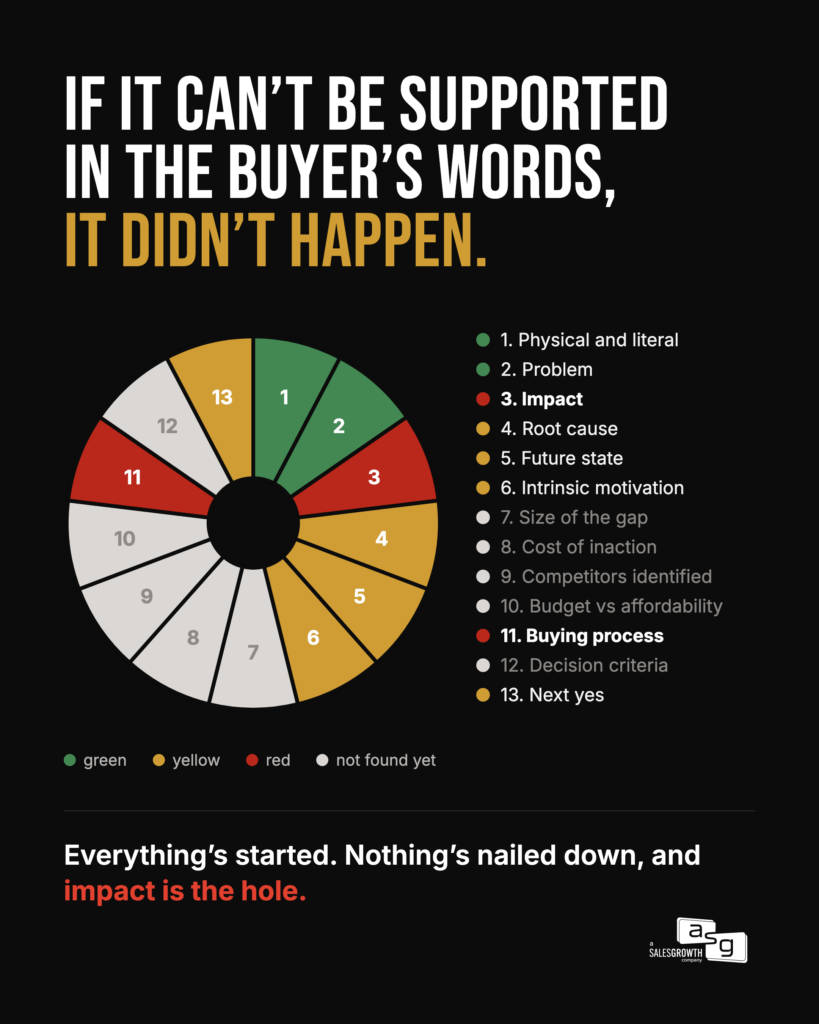
From there, three changes:
Change what a deal review asks. Stop opening with “where is it and when does it close.” Open with “show me the pie.” The manager’s job becomes finding the empty slices and coaching to go get them.
Teach reps what good looks like. Reps do not fill pies by being told to. They fill them by learning how to run discovery that produces this kind of evidence, which is what the Problem Identification Chart is for.
Tie the forecast to the color. If red deals cannot be committed, the whole org learns what actually matters in about a quarter.
You’ll know it’s working when a rep says “I can’t call this deal green yet” before a manager has to say it for them.
What should you read next to see your pipeline on evidence?
Two things to take with you. The Buyer Input Data e-book lays out what evidence-based deals look like next to opinion-based ones, and the How Buyers Want to Be Sold report gives you the buyer-side research behind why the stage model keeps missing.
Frequently asked questions
Should we delete sales stages from our CRM?
Not necessarily. Keep the stages your systems need for reporting and revenue operations, and stop using them as the measure of deal health. The color of the pie becomes the number your reviews and forecast run on.
How is this different from MEDDIC, BANT or any other qualification checklist?
A checklist is usually a set of boxes the rep ticks based on their own read. BID is buyer evidence, captured as facts about the problem, its impact and the gap, which a manager can inspect and a forecast can be tested against. The difference is who the information came from.
What if a deal is green and still loses?
Green means the evidence is there, not that the outcome is guaranteed. What green gives you is a loss you can learn from, because you know what the buyer said and can see which piece of evidence turned out to be wrong.
Who decides whether a deal is red, yellow or green?
The evidence does. The rep collects and logs it, the manager inspects it in deal reviews, and the color is a function of how much is actually there rather than a judgment call anyone negotiates.
Does this work for transactional or high-volume sales?
The components stay the same, the depth changes. A short-cycle deal still needs a problem, an impact and a gap, it just needs less definition behind each one before you can call it green.
What do you do with a pipeline that comes back mostly red?
Treat it as an accurate read for the first time rather than a crisis. Rank the red deals by whether the missing evidence is gettable, go get it on the ones that are, and stop spending calendar time on the ones where nobody will give you anything.
About the source
This article is from A Sales Growth Company (ASG), the creator of Problem Centric® Selling and the architect of the Problem-Centric Operating System (PCOS™). It applies Buyer Input Data (BID), ASG’s structured set of problem-centric evidence that proves a deal is real, winnable and forecastable, to the question of whether sales stages still earn their place. BID is taught in the Skills Layer, captured in the Opportunity Layer and consumed in the Forecast Layer. To see where your deals stand, visit salesgrowth.com.
Sources
- Buyer Input Data (BID), its three core components and its role across the Skills, Opportunity and Forecast layers, is ASG’s model.
- ASG, How Buyers Want to Be Sold, a survey of more than 1,200 B2B buyers: 54% had to rescope or re-evaluate after starting their purchase, 41% bought the wrong solution the first time, 63% wished salespeople pushed them harder to think through their situation, 72% said the process focused more on the solution than the problem.
- Gartner, The B2B Buying Journey: Key Stages and How to Optimize Them, 2025, on the nonlinear, looping nature of B2B buying.
- Gartner, Less Than 50% of Sales Leaders and Sellers Have High Confidence in Forecasting Accuracy, 2020.
- Challenger Inc., Why are you losing to customer indecision?, 2023.
- Fast Company, The B2B buyer’s journey isn’t linear, 2023.
- Clari, Defining and Improving Your Sales Cycle Stages for Every Deal, 2021, cited as the counter-argument for stage-based consistency.
- The red, yellow, green pie thresholds (roughly a quarter filled, half filled, nearly full) are ASG’s framing of BID completeness.